


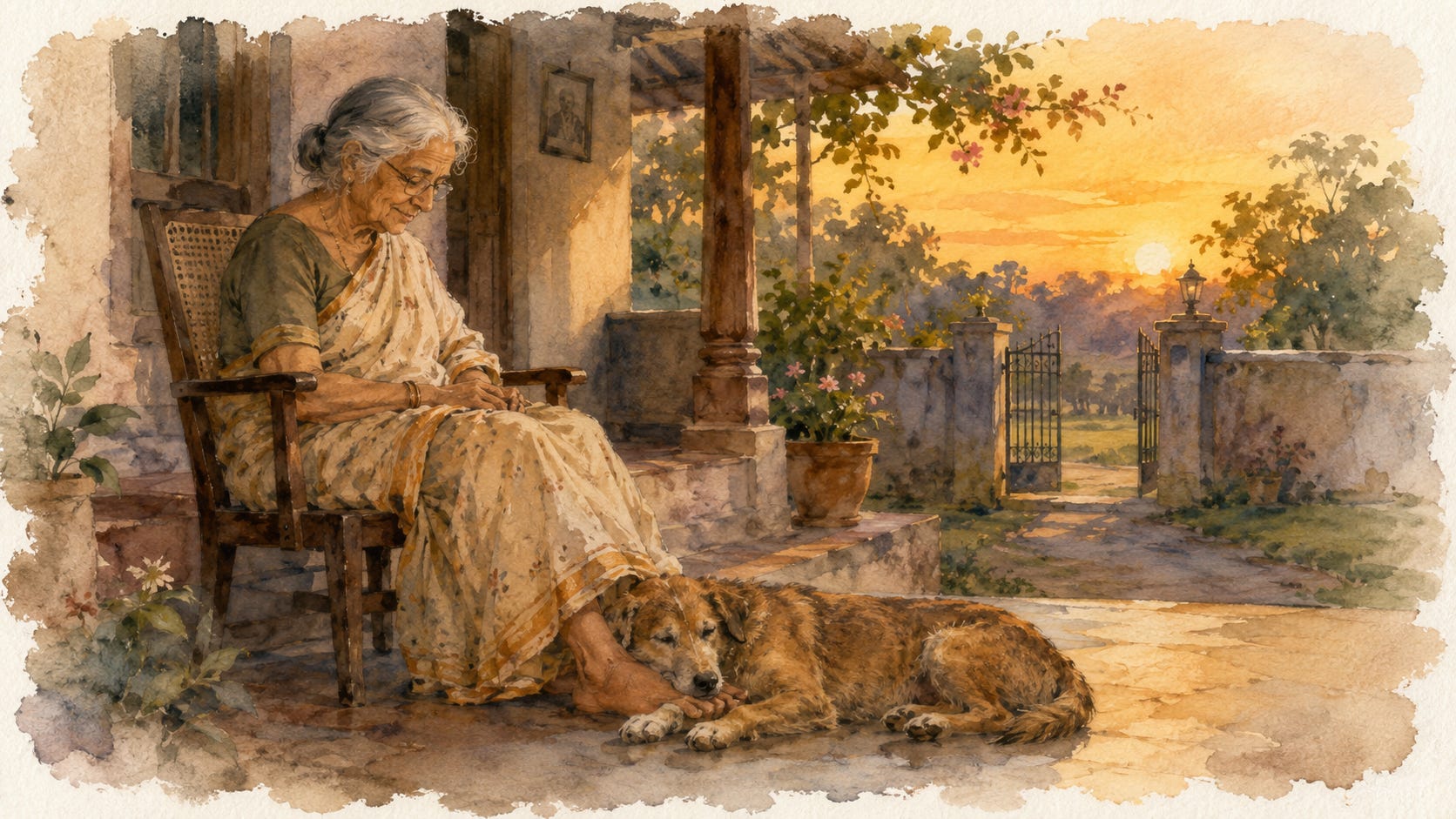
Every evening, around five-thirty, Leela Amma would open the gate and stand there for a minute or two, a gentle anticipatory smile gracing her pleasant face.
There was no real reason to do it anymore. Still, some habits become part of your body.
For years, that was the time her children came home from school. Two boys crashing through the gate with muddy shoes and loud voices, and her daughter running ahead of them, laughing and talking before she even caught her breath.
It would then be tea, chatter, homework, play—until her husband returned from work at eight, tired and hungry, loosening his watch strap as he stepped inside.
And after the children grew up and left for America, Canada, and Australia, and after her husband left this world altogether, there was still someone waiting for her.
Bruno.
An old, bronze-coloured, mixed breed dog with stiff legs, cloudy eyes, and a heart that seemed to understand her better than most people.
When she sat alone on the veranda, Bruno rested his head on her feet, barely moving. He didn’t need to, nearly no one ever came through the gate anymore.
When she cried after the weekly video calls... calls filled with love, but also hurry, Bruno stayed.
“Amma, we miss you so much.”
“Did you take your medicines?”
“Sorry, Amma, the kids have practice.”
“We’ll call properly this weekend.”
The face she had waited all week to see disappeared from the screen, and the house would become quiet again. Maybe a leaky faucet somewhere would make a drip sound. It seemed to echo in the silence.
But Bruno never rushed anywhere.
He simply raised his eyebrows, eyes looking softly up at her, tail thumping gently on the carpet... As if to say, I’m here.
And somehow, that was enough.
The neighbours often said, “You are lucky. All your children are settled abroad.” She simply smiled and nodded.
Yes, they were doing well.
And she was proud.
But pride does not sit beside you when the power goes out.
... Or ask if you have eaten.
... Or lie on your lap.
Years passed...
Her knees hurt more. Her hands trembled a little when she poured tea.
Bruno, too, became slower.
One rainy afternoon, she was sitting in her old wooden chair, knitting a sweater for a grandson who lived in a country where winters were colder than anything she had ever known.
Bruno got up from his mat and walked toward her.
Slowly.
Deliberately.
He rested his head on her feet, just as he had done thousands of times before.
She absentmindedly stroked his ears.
“Good boy,” she whispered.
After a few minutes, she noticed how still he was.
Too still.
She bent down and caressed him. She got down from her chair to sit beside him. It was painful to sit so low. To bend knees.
But Bruno was gone.
Just like that.
At her feet.
Where he had always been.
Leela Amma sat there for a long time with her hand on his fur. Her heart was hurting, a single tear caressed her wrinkled skin.
The rain tapped on the roof in gentle rhythm.
The pressure cooker hissed softly in the kitchen.
And for the first time in many years, the house felt unbearably empty. That night, Leela Amma woke up several times, she could not sleep, but drifted off. The walls seemed to be closing in on her. It was suffocating.
When Bruno died, it was not just the loss of a dog.
It was the loss of the last creature who had needed her every single day.
A few weeks later, she slipped in the bathroom. Nothing serious. Just a fright. But it was enough.
The children called immediately.
“Amma, we are worried.”
“You should not stay alone anymore.”
“There is a very good old age home nearby.”
“They will take excellent care of you.”
Their voices were full of concern.
And guilt.
And helplessness.
She understood all of it.
She did not blame them.
Life had carried them far away.
That is what parents spend their whole lives helping their children do.
She packed six sarees, her Bhagavad Gita, a framed photo of her husband, and Bruno’s old collar.
At the old age home, while she waited in reception, another woman sat beside her. Her hair was completely white, tied into a loose braid. There was something calm about her face.
As if she had already cried all the tears she needed to cry.
“First day?” the woman asked.
Leela Amma nodded.
The woman smiled.
“My son brought me here four years ago,” she said. “He said it was temporary.”
She paused, then continued looking straight ahead, “I waited for him every Sunday.”
Another small smile.
“Then one Sunday, I stopped waiting.”
Leela Amma looked at her...silence stretched for a few minutes. The woman continued.
“That was the day this place stopped feeling like abandonment and started feeling like shelter.”
She pointed toward the dining hall, where a few elderly women were laughing over cups of tea.
“We all came here carrying the same story in different forms.”
Then she turned to Leela Amma and said, very softly:
“Our children probably never meant to abandon us. Perhaps their lives became bigger and busier, and somehow we never fit into that”.
The receptionist called Leela Amma’s name.
Leela Amma stood up.
She touched the collar inside her handbag.
For a moment, Leela Amma was sure she saw her children as they once were—small, noisy, and contantly hungry. She saw her husband smiling at the gate. She felt Bruno’s warm head resting on her feet.
An entire lifetime of being needed.
Of cooking, waiting, worrying, and loving.
She took a slow breath and released it intentionally.
Then she looked at the woman beside her. The woman smiled back as if she already understood.
Leela Amma walked to the desk and signed the form.
And as she handed it over, she smiled.
A real smile.
After spending her whole life making a home for everyone else, she had found a place where she, too, could be cared for.
Very sweet. Yes, it's not easy at all for anyone in this situation.
Awww I love this 😭 so innocent and tender all the way through. I was aching for her. ❣️