

The Things We Mend
Sometimes the kindest thing we can do is leave room for another person's story.

A month into the new academic year, the 10-year-old came back with his school bag wide open, as if it were in a silent scream.
As I saw him enter the house, I wondered if he had lost half its contents.
"Mamma, it broke!" he declared.
That night, on seeing the broken zipper, his father made another declaration.
"I need to make you bags from iron!"
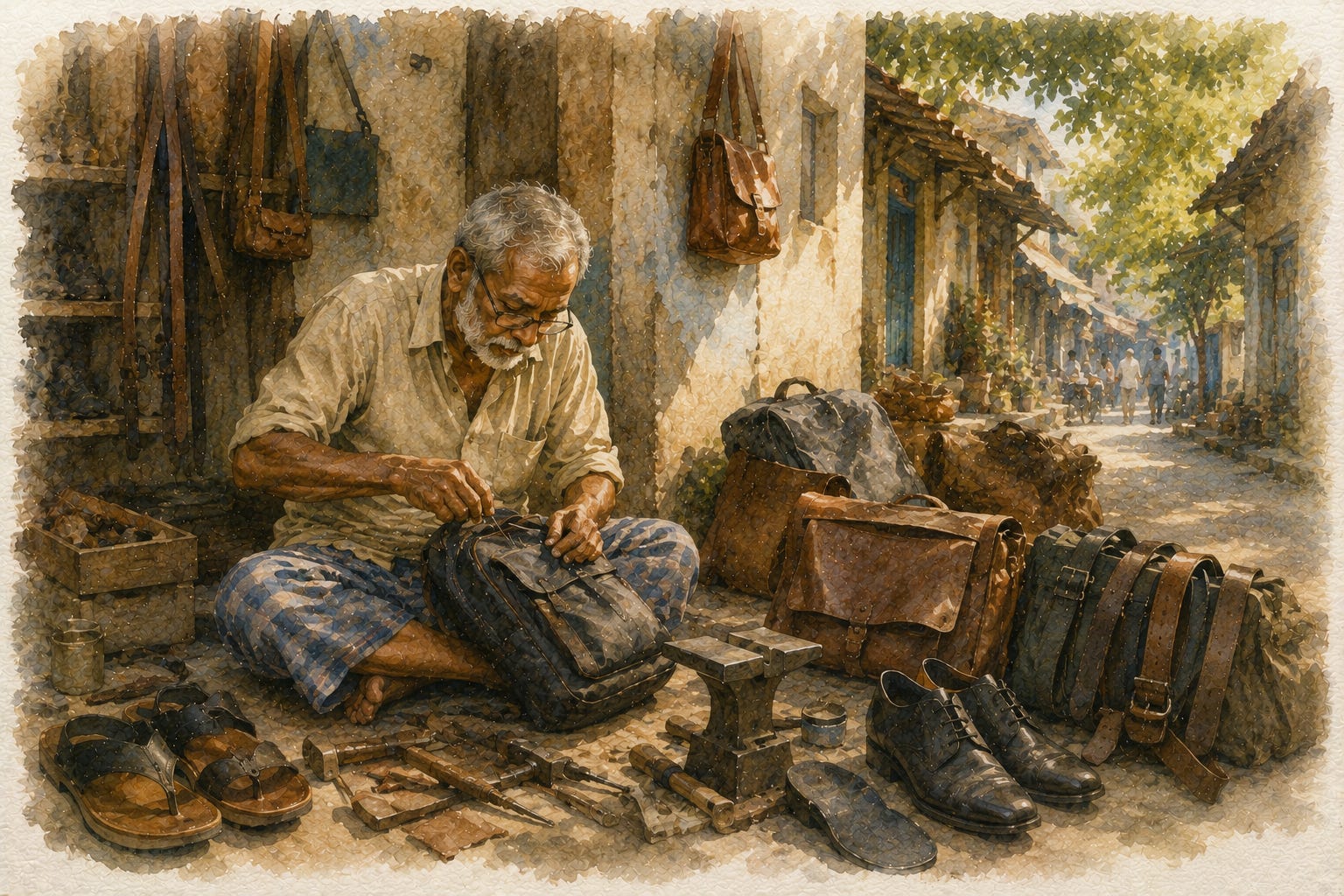
Since an iron bag is, thankfully, not possible, and because the bag was still practically new, I decided to seek out a craftsman who is becoming very much extinct nowadays—the cheruppukuthi—the mochi. Also known as the Indian cobbler.
Once upon a time, they were readily seen as part of the Indian scenery. They sat in tiny spaces at street corners, surrounded by bags, shoes, belts, and purses, with an anvil held tightly between their feet, which met face to face in what modern yoga calls the butterfly pose. The Indian cobbler had perfected this yogasana long before it found its way into yoga studios.
Now they are a rare species. Changing fashions and the convenience of buying new accessories have made us replace rather than repair.
But, as I said, the bag was practically new. So I picked up that bag and another that had a small tear but was otherwise perfectly usable. For good measure, I added two pairs of footwear. I might as well make the trip worthwhile, I thought.
I went to the old market. The place still had its old peedikas (shops). Decades ago, it had been a thriving marketplace. As a child, my father used to bring handmade kaithola paayas (woven grass mats) here to sell. Now the whole place had changed.
Outside stood supermarkets and beautiful new buildings. Inside, the old market was made up of the last of the limestone-and-clay-brick buildings — weather-beaten, battered amd crumbling.
I found my cheruppukuthi tucked away among piles of old bags and shoes in a quiet corner, sitting in the cobbler's pose with an anvil between his feet, bent over his work.
I was on my two-wheeler. I parked it in front of his workspace. The road was hardly wide enough for two two-wheelers to pass each other.
He didn't lift his head.
I watched him deftly insert a needle, lock in a thread, and pull it through the slipper he was repairing.
Then he looked up.
"Hmm?"
He peered at me over the top of his glasses. He must have been in his sixties. His face looked tired, and his expression leaned more towards a scowl than a smile.
"Chetta, can this zipper be replaced?" I asked, showing him the bag.
"Yes. You can take it now itself. Move your scooter. Autos have to pass through."
He said it all in one breath.
I took out the other bag and the footwear. I began rattling off what needed to be done.
At this, he got annoyed.
"So many! I thought it was only this bag!"
Aren't many repairs good for business? I wondered.
"Take this bag."
He quickly replaced the zipper.
I took it and pushed the other items towards him again.
"I don't have time," he replied gruffly.
Then he picked up the footwear.
"I'll give this on Monday."
I tried to get him to look at the other bag again.
He flatly refused.
"Look at all these."
He gestured around him.
His tiny workspace was brimming with old footwear and bags.
"People bring them to be repaired. They never come back," he barked.
I paid for the repaired bag and left my footwear with him. He told me to come back the following Monday.
I went home and had a laugh recounting my encounter with the cobbler to my mother-in-law.
"I won't blame him," I said. "Imagine spending your time mending things, only to wait... and no one comes back for them."
Monday came.
But my six-year-old fell sick.
My mind went back to the cobbler.
Would he look at my footwear and think, "Sneaky woman. I knew she wouldn't come back"?
The next day, I had to go out for a few things. So I went to the cheruppukuthi.
"Which were your footwear?"
We rummaged through the pile and found them.
He hadn't touched them.
"I'll do them for you now. Wait five minutes."
His voice was a little different.
The gruffness was gone.
I stood there for a while, then slowly wandered into the dilapidated peedika next door, drawn by a few things that caught my eye.
A completely unnecessary pink mop, wallpaper for a sudden DIY whim, and a velvet doormat later, I was back.
A three-year-old was screaming at the top of his lungs while his father scolded him.
I found the cobbler chuckling.
The father asked, "Do you want a beating?"
"Yes!" the child replied.
The cobbler was roaring with laughter as he repeated the exchange to me, his eyes twinkling.
I laughed with him.
My heels were looking as good as new.
He picked up my other pair—a pair of wedges. One side had come apart. He stitched it back together, and then, for good measure, he stitched up it’s twin too.
"Seventy rupees," he said.
I paid and left.
The skies were gathering dark clouds like a woman collecting ripe mangoes in the thala of her saree—the loose end draped over her shoulder.
Then, as though the thala had slipped from her hands and all the mangoes had tumbled to the ground, the clouds burst open.
I smiled to myself.
The other day, the cheruppukuthi must have been having a bad day.
I didn't judge him.
And perhaps...
I was right.

He mended things
for people
who never came back.
She came back.
That was the whole story.
Sometimes that is
the whole story.
— AËLA
Sheeba, thank you for sharing this with us. Reflects you kindness, humility and understanding. My heart sank when i read people never came back and he mended the things. Such indifference...but your attitude shines. Much love to you ❤️